


Earned Settlement 2026: Can the ILR Changes Be Challenged?
Earned Settlement ILR changes 2026: Can the 10-year rule be legally challenged?
The UK's earned settlement reforms can be challenged in court, but a blanket challenge on behalf of everyone is the hardest version of the case. The strongest legal arguments are narrower, and UK courts have upheld arguments of that kind before.
On 2 November 2026, Home Secretary Shabana Mahmood confirmed that the standard qualifying period for Indefinite Leave to Remain (ILR) will rise from 5 years to 10 years for most migrants. The change applies to people already in the UK who do not yet hold ILR. The Home Office estimates over 500,000 people will settle later than under the current rules.
Is it law yet? No. The policy, set out in A Fairer Pathway to Settlement: Government Response (CP 1707), must be written into the Immigration Rules. Those changes are expected from December 2026, with implementation during 2027.
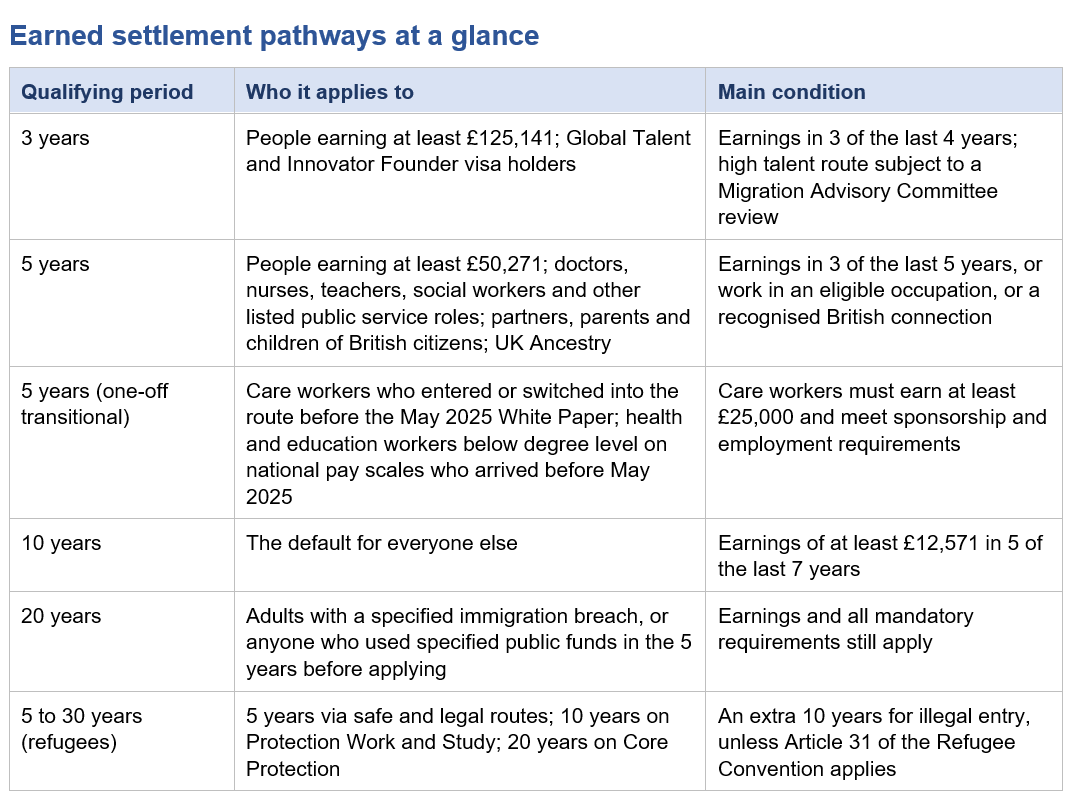
Settlement takes 3 years for those earning at least £125,141, and 5 years for those earning at least £50,271, eligible public service workers and people with a British connection. It takes 20 years after an immigration breach or recent use of public funds, and up to 30 years for some refugees.
Can it be challenged? Yes, by judicial review once the new Rules are laid. In R (Ooi) v SSHD [2007], work permit holders lost a challenge to a 4-to-5-year ILR increase. In R (HSMP Forum(UK) Ltd) v SSHD [2009], highly skilled migrants won a challenge to the same increase, because the government had made them a specific promise.
Where challenges are strongest: specific written promises to defined groups; people who have already completed five years before the Rules start; new penalties for past conduct; and mandatory requirements placed in guidance rather than the Rules.
The Skill Migrants Alliance has instructed lawyers on a potential judicial review. A House of Lords committee called retrospective application "manifestly unfair" in June 2026.
What is earned settlement?
Earned settlement is the UKgovernment's new framework for indefinite leave to remain. It replaces thenear-automatic five-year route with a default 10-year qualifying period that can be shortened or lengthened by earnings, occupation, conduct and immigration history. It was proposed in the May 2025 Immigration White Paper, consulted on from November 2025, and confirmed in CP 1707 on 2 November 2026.
Mandatory requirements for everyone
Every applicant must also pass five gates that cannot be offset by high earnings or public service:
1. No criminal record. Any adult UK criminal record leads to refusal, including cautions, conditional discharges, court fines and community sentences.
2. No government debt. This includes NHS debt, unpaid tax and National Insurance, and litigation costs owed to the Home Office.
3. B2 English, equivalent to A-level in a foreign language.
4. The Life in the UK test.
5. Sustained contribution: earnings of at least£12,571, or £25,142 combined for eligible couples.
Other notable changes: the10-year Long Residence route closes; time on Student, Graduate, Youth Mobility, intra-company, and Ukraine scheme routes will not count; and existing ILR holders keep their status. Hong Kong BN(O), Afghan scheme and armed forces routes keep their own timelines but must meet the new criminality and English requirements.
Does the 10-year ILR rule apply to people already in the UK?
Yes. Unless a transitional arrangement protects them, the new rules will apply to anyone who has not been granted ILR when their application is decided. The Home Office estimates that over 500,000 people will settle later than they otherwise would, cutting forecast settlement grants for 2026 to 2030 from 1.9 million to 1.4 million (CP1707, Annex A).
The Home Office's legal position
Chapter 8 of CP 1707 states the government's view directly. Successive governments have always kept the power to change the Immigration Rules. Unless transitional provisions say otherwise, applications are decided under the rules in force on the date of decision. Being in the UK does not give someone an automatic right to settle under the rules that applied on arrival.
This reflects established case law, including the House of Lords decision in Odelola v SSHD [2009] UKHL25. The Immigration Minister has said he is confident there are no grounds to challenge the policy.
Is it "retrospective" in law?
In everyday language, changing the rules mid-journey feels retrospective. In law, the test is narrower. In R(Ooi) v SSHD [2007] EWHC 3221 (Admin), the High Court applied the classic definition: a rule is retrospective if it "takes away or impairs a vested right" or "attaches a new disability, in regard to events already past" (para 42).
On that test, Ooi held that lengthening the qualifying period was not retrospective for people who had not yet completed it. Their right to apply was not removed, only "deprived of purpose" (para 44). But the court added a crucial caveat. For anyone who had already completed the qualifying period, a new requirement would have created a new obligation about past events (para 45).
Who is protected
• People who already hold ILR keep it. The government says settled status will never be removed from anyone who holds it.
• Care workers and some sub-degree public service workers who arrived before the May 2025 White Paper keep a five-year route if they meet their visa requirements.
• Family members of British citizens, Hong Kong BN(O)visa holders and members of the armed forces keep their existing timelines.
• Skilled workers on pre-April 2024 salary rules can extend on their current terms until 2035, rather than 2030.
The government treats the May 2025 White Paper as fair notice that the five-year route would change. Whether a public announcement is enough notice has been tested before, and that is one of the questions a court may be asked to revisit.
What is legitimate expectation in UK immigration law?
Legitimate expectation is a public law principle: if a public body makes a clear promise about how it will act, a court can require it to keep that promise unless there is a good reason not to. A "substantive" legitimate expectation protects a promised outcome, such as settlement after a set period, rather than just a fair process. The leading case is R v North and East Devon Health Authority, ex parte Coughlan [2001] QB 213.
The test in five questions
UK courts and tribunals have applied the principle to immigration rule changes through five practical questions:
1. Was there a clear promise? The representation must be "clear, unambiguous and devoid of relevant qualification". The Upper Tribunal in Mehmood [2014] called this "the first question in every case".
2. How would a reasonable reader understand it? The test is objective. A sensible reader of Home Office guidance knows the rules change frequently, and reads the guidance as a whole, as mentioned in AA and Others[2008].
3. Who was it made to? A specific undertaking to a defined group carries more weight than a general statement to the public (R(Bhatt Murphy) [2008], cited in Mehmood).
4. Can the government justify breaking it? A promise can be broken only where that is a proportionate response to a legitimate aim in the public interest. Courts intervene less in the "macro-political field" of policy affecting large numbers of people (ex parte Begbie [2000]; Nadarajah [2005]).
5. Could the promise lawfully be kept? A court will not enforce a promise that would require an official to act contrary to the Immigration Rules (Mehmood, para 20).
Why this matters for earned settlement
Most migrants on five-yearroutes were told what the rules were, not promised that the rules would never change. In the case law, that distinction usually decides the outcome. The next section shows how.
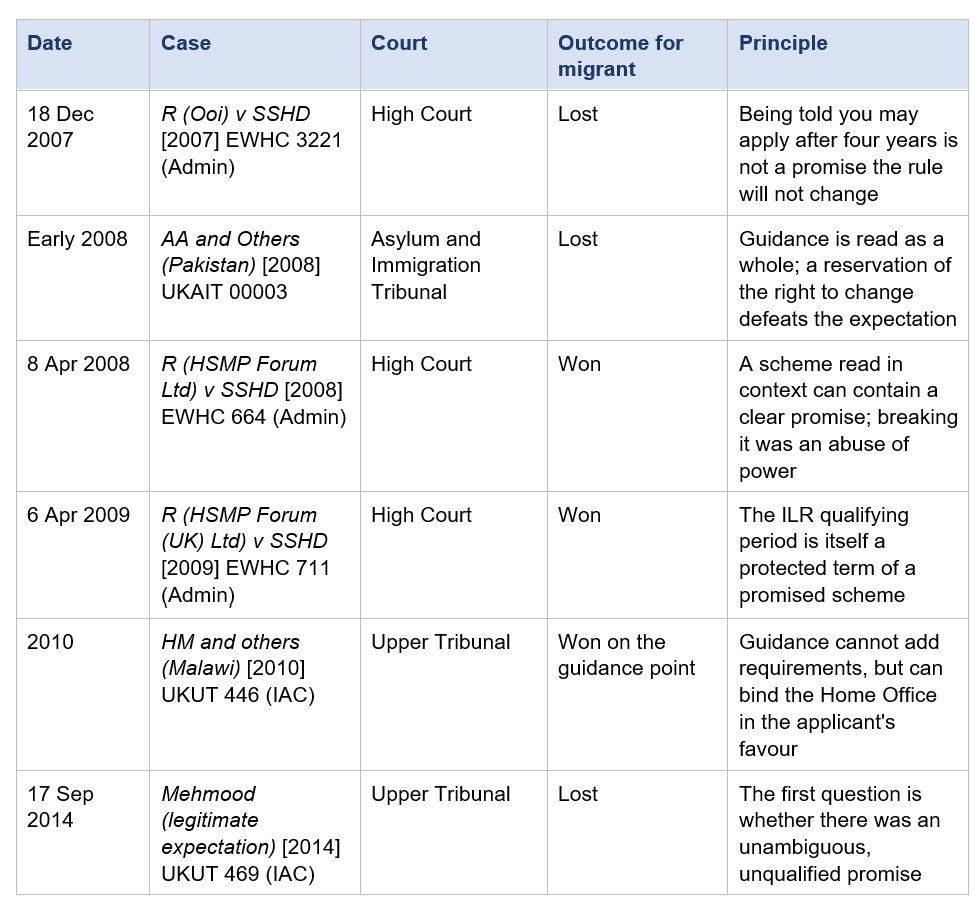
Six key cases on changing ILR rules (2007 to 2014)
The UK has extended the ILR qualifying period before. In April 2006, it rose from four years to five, with no transitional provisions. Two groups challenged that change: work permit holders lost, and highly skilled migrants won. The six cases below explain why.
R (Ooi) v SSHD [2007] EWHC 3221 (Admin)
Five chefs on 2002 work permits challenged the April 2006 increase from four to five years. Their permits said they could apply for ILR after four years, but that described the rules rather than promising they would not change. The change was amacro-political decision affecting very many people, so the court would not intervene. Having to "wait one more year" did not breach Article 8.
AA and Others (Highly skilled migrants: legitimate expectation) Pakistan[2008] UKAIT 00003
HSMP migrants refused extensions under a tougher November 2006 points test lost their appeals. The Tribunal held that a reasonable reader would see the guidance's reservation of the right to change the criteria (paras 85 and 94). Even if a promise existed, the large class affected and the policy's macro-political nature would let the public interest prevail (paras 99 to 104).
R (HSMP Forum Ltd) v SSHD [2008] EWHC 664 (Admin)
A representative body of HSMP members challenged the same November 2006 changes and won. Sir George Newman read the scheme as a whole: it was designed as a path to settlement and required migrants to make the UK their main home (para 52). Guidance told existing members they could settle after four years "regardless of revisions"(para 55). The Home Office's own data showed few people were affected, so breaking the promise was "conspicuous unfairness and an abuse of power" (paras 59 to 61).
R (HSMP Forum (UK) Ltd) v SSHD [2009] EWHC 711 (Admin)
The Home Office then kept the April 2006 increase from four to five years for HSMP members, arguing the qualifying period was mere timing. Mrs Justice Cox rejected that distinction as"so nuanced as to be almost Delphic" (para 52). The Home Office'scounsel accepted his argument would be the same if the period rose from 4 to10, or even 15, years (para 53). A Parliamentary announcement did not displace the expectation, because published guidance still said four years (para 41). Withholding ILR at four years from existing members was unlawful (para 79).
HM and others (Malawi) [2010] UKUT 446 (IAC)
Following Pankina v SSHD[2010] EWCA Civ 719, the Upper Tribunal held that guidance not laid before Parliament cannot add mandatory requirements. Published guidance can, however, create a legitimate expectation that the Home Office will follow it in theapplicant's favour (para 14).
Mehmood (legitimate expectation) [2014] UKUT 469 (IAC)
A Tier 2 migrant relied on a UK Border Agency email explaining why his leave was granted to take his total stay to five years. The email explained the rules and promised nothing about continuous residence (paras 18 and 19). Even an unambiguous promise of ILR would not have been enforced if it required the official to act against the Immigration Rules (para 20).
Possible grounds for challenging the earned settlement rules
On the case law, a general legitimate expectation claim for everyone moved from five to ten years looks closer to Ooi than to HSMP Forum. The more promising grounds are narrower and more technical.
Ground 1: a specific promise to a defined group
A GOV.UK statement that you "can apply after 5 years" mirrors the work permit condition in Ooi, which was not enough. What won in HSMP Forum was guidance telling existing members they would be unaffected "regardless of evisions". Route guidance, recruitment campaigns, ministerial statements and sponsor communications should be checked for wording of that kind.
The Hong Kong BN(O) route is a notable test case. CP 1707 lists it among "Existing Government commitments" it will "continue to honour", yet applies B2English and the new criminality bar. HSMP Forum (UK) rejected the idea that a promise protects only some of a scheme's terms (para 52). The counterweight is scale: the Home Office expects 117,000 BN(O) main applicants and 78,000 dependants to settle between 2026 and 2030.
Ground 2: people who have already completed five years
Ooi indicated that imposing a new requirement on someone who has already completed the qualifying period would be retrospective (para 45). In 2006, the Home Office decided to accept applications from people who had already qualified and applied before the change under the old rules (para 24). If the new Statement of Changes gives no equivalent protection, that is the clearest retrospectivity argument.
Ground 3: new penalties for past conduct
Earned settlement turns a historic caution or conditional discharge into a permanent bar, and a past overstay into a 20-year path. Applying new consequences to events that have already happened is the core of the retrospectivity test quoted in Ooi(para 42).
Ground 4: requirements hidden in guidance
CP 1707 leaves important detail, including which public funds count and which exemptions apply, to guidance" before implementation". Under Pankina (applied in HM(Malawi)), and later confirmed by the Supreme Court in R (Alvi) v SSHD[2012] UKSC 33, a requirement that leads to refusal must be in Rules laid before Parliament.
How would a legal challenge to the ILR changes be brought?
A challenge would most likely be a judicial review in the Administrative Court of the High Court, brought once the new Immigration Rules are laid before Parliament. The tribunal appeal route used in AA (2008) is no longer available for most cases after the Immigration Act 2014, and a refusal of ILR usually carries no right of appeal unless a human rights claim is refused.
The usual sequence
1. The Rules are laid. The government must publish a Statement of Changes to the Immigration Rules. This is expected from December 2026, with implementation during 2027.
2. Pre-action letter. The claimant writes to the Home Office setting out the proposed grounds, under the pre-action protocol for judicial review.
3. Claim issued. A claim must be brought promptly and in any event within three months of the grounds arising (CPR 54.5).
4. Permission. A judge decides whether the claim is arguable enough to proceed.
5. Full hearing and remedy. If the claim succeeds, the court can grant a declaration or quash the unlawful part of the decision.
Lessons from the HSMP litigation
• Use a representative claimant. Both HSMP wins were brought by a company representing affected migrants, not by one individual.
• Evidence the hardship. Mrs Justice Cox read every witness statement, which described mortgages, careers, travel restrictions and overseas tuition fees for children (HSMP Forum (UK), para 75).
• Use Parliament's findings. Both judgments relied on the Joint Committee on Human Rights' criticism of the 2006 changes.
• Test the government's own figures. In 2008 the court found the Home Office's data showed too few people were affected to justify breaking the promise (HSMP Forum, paras 59 and 60).
• Ask for targeted relief. Neither HSMP claim sought to quash the rule change itself. Both won declarations that it could not lawfully be applied to people already on the scheme.
Who is preparing a challenge?
The Skill Migrants Alliance, acommunity-led group of skilled migrants, has instructed Kingsley Napley LLP. Sonali Naik KC and David Sellwood of Garden Court Chambers are advising on a potential legal challenge, first announced in February 2026.
On 23 June 2026, the House of Lords Justice and Home Affairs Committee found retrospective application "manifestly unfair", because people had made life-changing decisions based on the existing rules. It also criticised the absence of a full impact assessment during the consultation.
What can affected migrants do now?
The five-year route remains open until the new Rules take effect, so the most valuable step for anyone close to qualifying is to check whether they can apply under the current rules. The other steps below protect your position whatever happens in court.
1. Check your current eligibility. If you will complete five years before the new Rules start, find out when you can apply. Whether pending applications are protected will depend on the transitional wording in the Statement of Changes.
2. Work out your likely new pathway. Review your earnings for the last seven years against the £12,571, £50,271 and £125,141thresholds, and check whether your occupation is on the eligible public service list in Annex C of CP 1707.
3. Keep evidence of what you relied on. Save the guidance, recruitment material and employer or sponsor letters you were given, with dates. Record the decisions you made because of the five-year route, such as selling a home, moving children's schools or turning down jobs.
4. Check the mandatory requirements early. Look for any caution, fine or conviction, any unpaid NHS charges or tax, and how long you need to reach B2 English and pass the Life in the UK test.
5. Protect your compliance record. Apply in time, keep to your visa conditions, and take advice before claiming any public funds, because a breach or a recent benefit claim can lead to a 20-year path.
6. Get regulated advice. Speak to a solicitor or a regulated immigration adviser about your individual timeline and options.
Book a settlement eligibility review today.
Frequently asked questions
What is the new ILR rule in the UK in 2026?
Under the earned settlement framework confirmed on 2 November 2026, the standard qualifying period for indefinite leave to remain rises from 5 years to 10 years for most migrants. Higher earners, some public service workers and people with a British connection can still settle in 3 or 5 years.
When do the earned settlement rules come into force?
The earned settlement rules are not yet in force. The government's policy must first be written into the Immigration Rules through a Statement of Changes, expected from December 2026, with implementation during 2027.
Does the 10-year ILR rule apply to people already in the UK?
Yes. The 10-year rule applies to people already in the UK who have not been granted ILR, unless a transitional arrangement protects them. The Home Office estimates over 500,000 people will settle later than under the current rules.
Can I still apply for ILR after 5 years?
Yes, until the new Immigration Rules take effect, the existing five-year routes remain open to people who meet their requirements. After that, a five-year route will be available only to those earning at least £50,271, eligible public service workers, people with a British connection and protected transitional groups.
Who can get ILR after 3 years under earned settlement?
People earning at least £125,141in three of the last four years, and Global Talent or Innovator Founder visa holders, can qualify for ILR after 3 years. They must still meet every mandatory requirement, including B2 English and a clean criminal record.
Do care workers still get ILR after 5 years?
Care workers who entered or switched into the care route before the May 2025 Immigration White Paper keep afive-year route if they earn at least £25,000 and meet their sponsorship and employment requirements. Those who do not qualify can apply for a furtherfive-year Health and Care visa. Care workers who joined after May 2025 are on the 10-year route.
Will a police caution or fine stop me getting ILR?
Under earned settlement, any adult with a UK criminal record will be refused settlement. This includes cautions, conditional discharges, court-imposed fines and community sentences, as well as custodial sentences.
Can the earned settlement changes be challenged in court?
Yes, the changes can be challenged by judicial review once the new Immigration Rules are laid. Case law suggests the strongest grounds are specific promises to defined groups, protection for people who have already completed five years, new penalties for past conduct, and requirements placed in guidance rather than the Rules.
Has a UK court ever stopped the Home Office from extending the ILR qualifying period?
Yes. In R (HSMP Forum (UK)Ltd) v SSHD [2009] EWHC 711 (Admin), the High Court held it was unlawful to apply the 2006 increase from four to five years to people already on the Highly Skilled Migrant Programme. The decision turned on the government's specific written promise to HSMP members.
What is legitimate expectation in immigration law?
Legitimate expectation is a public law principle that can require the Home Office to keep a clear, unambiguous and unqualified promise about how it will treat a person or group. A court can allow the promise to be broken only where that is a proportionate response to an overriding public interest.
Will people who already have ILR lose it?
No. The government has said settled status will never be removed from anyone who already holds it. The earned settlement changes apply only to people who have not yet been granted ILR.
What happens if I do not qualify for ILR under the new rules?
The government has said no one will be forced to leave because of the changes. People who do not qualify for an earlier pathway can apply to extend their visas and work towards the 10-yearor 20-year pathway.
Legal disclaimer
This article is general information about the UK earned settlement proposals and the related case law, current at 12 November 2026. It is not legal advice and does not create a lawyer-client relationship. The Immigration Rules implementing earned settlement have not yet been published, and the detail may change. Anyone affected should take advice from a solicitor or regulated immigration adviser on their own circumstances.
How we help?


Over 400 cases solved
At GigaLegal, we treat your legal matters with the same care and urgency as if they were our own. Our highly experienced solicitors are committed to protecting your rights, freedoms, and future. With a results-driven mindset and a deep sense of responsibility, we work tirelessly to deliver the strongest possible outcome for every client we serve.


Aldgate branch
Dagenham branch

Over 1000
success stories


