





UK Earned Settlement Reforms 2026
The UK Government is currently considering one of the most significant changes to immigration policy in recent years. The proposed Earned Settlement system would fundamentally alter how migrants qualify for Indefinite Leave to Remain (ILR), the status that allows people to live and work in the UK permanently.
This article explains what is being proposed, who will be affected, and what the changes could mean in practical terms. It is written for migrants currently living in the UK, those planning to settle here, and employers who rely on overseas workers.
What Is Indefinite Leave to Remain (ILR)?
Indefinite Leave to Remain —commonly referred to as ILR or settlement, is the immigration status thatallows a person to live in the United Kingdom permanently, without any time restriction on their stay.
Once granted ILR, a person can:
- Live in the UK without immigration conditions
- Work in any job, for any employer, without restriction
- Access public funds, including NHS services and certain benefits
- Apply for British citizenship after holding ILR for one year
Under the current rules, most migrants can apply for ILR after five years of continuous lawful residence in the UK on a qualifying visa. The most common qualifying routes include:
- Skilled Worker visa
- Health and Care Worker visa
- Family visa (spouse, partner, or parent of a British citizen or settled person)
To be eligible, applicants must currently satisfy a number of requirements, including passing the Life in the UK Test, demonstrating English language ability at the required level, and paying the ILR application fee.
The Government is now proposing to change this system substantially through the introduction of an Earned Settlement model.
What Is the Proposed Earned Settlement System?
Under the Government's proposals, the standard five-year route to ILR would be replaced by a new model in which migrants must demonstrate their contribution to the UK before becoming eligible for permanent settlement.
The 10-Year Baseline
The central change is the introduction of a 10-year baseline qualifying period. Instead of being eligible for ILR after five years, most migrants would need to have lived lawfully in the UK for a minimum of ten years.
However, this baseline period is not fixed. It can be reduced or extended depending on a migrant's circumstances, economic contribution, and income level. The proposed system is designed to reward those who contribute most to the UK economy with a faster route to settlement, while those in lower-paid or lower-skilled roles could face a significantly longer wait.
Proposed Settlement Timelines by Category
The following table sets out the proposed settlement timelines under the Earned Settlement model:

New Requirements for UK Settlement
Alongside the extended baseline period, the Government intends to introduce a set of mandatory conditions that migrants must satisfy before they can apply for ILR. These go beyond the existing requirements and represent a more structured assessment of a migrant's contribution and integration.
The proposed new requirements include:
• A minimum income threshold of £12,570 per year
• English language ability at B2 level (upper intermediate)
• Passing the Life in the UK Test
• No serious criminal convictions
• No outstanding government debt, including tax liabilities or NHS debt
The underlying principle is that those seeking permanent residence in the UK should be economically active and financially independent. The income threshold of £12,570 corresponds to the National Living Wage annual income for a full-time worker.
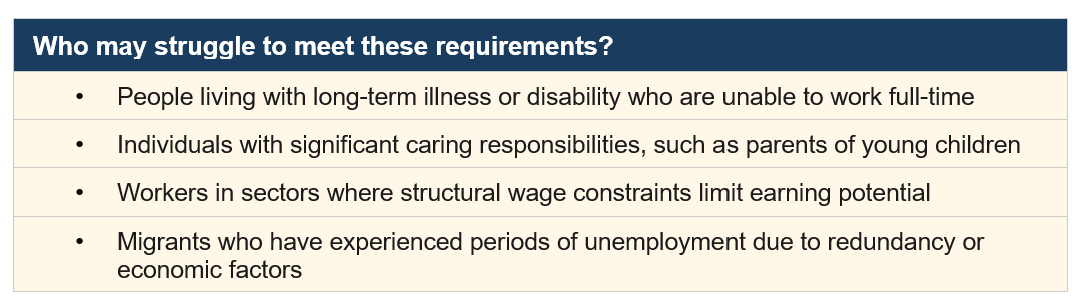
The Home Affairs Committee has acknowledged that while the principle of encouraging economic participation is reasonable, the policy must include clear and accessible exemptions for individuals who cannot meet the income requirement for legitimate reasons. Without these safeguards, vulnerable groups risk being excluded from settlement through no fault of their own.
Faster Settlement for High Earners
One of the more notable features of the Earned Settlement model is the provision for high earners to qualify for ILR significantly faster than the 10-year baseline.
The proposed framework would allow migrants earning above certain income thresholds to reduce their qualifying period as follows:
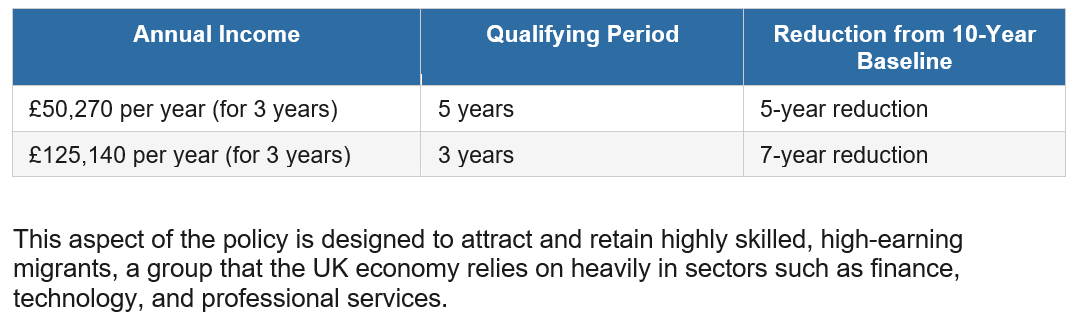
The Home Affairs Committee noted that while rewarding economic contribution is a legitimate policy objective, the specific income thresholds chosen appear somewhat arbitrary and may produce unintended or inequitable outcomes in certain cases.
Impact on Skilled Workers and Care Workers
One of the most debated areas of the proposed reforms concerns medium-skilled workers, and in particular, those working in the adult social care sector.
The Social Care Context
Between 2022 and 2024, the UK saw a significant increase in migrants arriving under the Health and Care Worker visa route. Many of these individuals were actively recruited by UK employers to address critical staffing shortages in adult social care, a sector that provides essential services to elderly and disabled people across the country.
Social care roles are, by their nature, relatively low-paid. Many of the workers who came to the UK during this period have families and dependants who accompanied them or joined them later.
What the Reforms Could Mean for Care Workers
Under the proposed Earned Settlement model, many medium-skilled workers, including a significant proportion of those employed in social care, could face a 15-year route to settlement.
The Home Affairs Committee has raised serious concerns about the potential consequences of this extended timeline:
• Increased financial hardship for migrant workers and their families during the extended qualifying period
• Greater vulnerability to workplace exploitation, as workers on temporary visas have less bargaining power and fewer protections
• Staff shortages and increased cost pressures in a social care sector already under considerable strain
A further concern raised in the report is that these immigration reforms appear to have been developed without a coherent parallel strategy for the adult social care workforce. The two policy areas are closely connected, and treating them in isolation risks compounding existing pressures in an already stretched sector.
Possible Impact on Migrant Children
The report draws specific attention to the position of children in migrant families, an area that has not received as much public attention as the headline changes to settlement timelines, but which carries significant long-term implications.
The concern centres on two related scenarios:
• Children who arrive in the UK at a young age and spend their formative years here, but whose parents remain on temporary visas throughout that period
• Young people who turn 18 before their parents have completed the qualifying period for settlement, leaving them in an uncertain immigration position as adults
The Home Affairs Committee's recommendation on this point is clear: children who grow up in the UK should have straightforward and realistic pathways to settlement, and should not face immigration uncertainty as they enter adulthood simply because of the length of their parents' qualifying period.
There is also a broader concern that the proposed reforms could increase child poverty, particularly among families employed in social care and those already on the 10-year family or private life immigration routes.
Will the New Rules Apply to People Already in the UK?
This is one of the most pressing practical questions arising from the proposed reforms, and it is one that the report addresses directly.
A significant number of migrants currently living and working in the UK entered the country on the understanding that they would qualify for ILR after five years. They made major life decisions: accepting job offers, enrolling children in schools, signing tenancy agreements, planning family commitments, based on that expectation.
The Government is considering whether the new rules should apply to migrants who are already on a route to settlement. If they do, many people could find their qualifying period extended considerably, with limited notice and no opportunity to plan for the change.
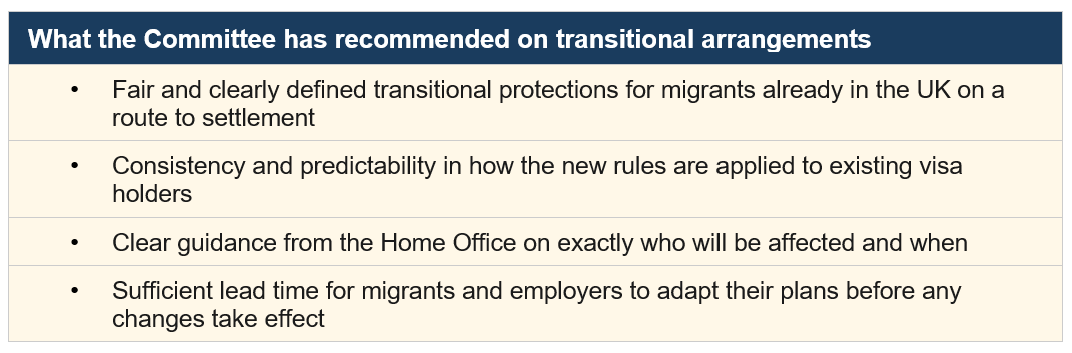
The report acknowledges that retrospective changes to immigration policy are not without precedent. However, it emphasises that the scale and significance of these proposals make robust transitional arrangements not just desirable but essential.
Why Is the Government Proposing These Changes?
Understanding the Government's rationale is important context for anyone seeking to assess these proposals.
The Government has set out three main reasons for the proposed reforms:
• High migration levels in recent years, which have placed pressure on public services and generated significant political debate
• Concerns about public spending once migrants gain settlement and become eligible for the full range of public funds and services
• A desire to ensure that settlement reflects genuine economic contribution and integration into UK society, rather than simply the passage of time
These are not unreasonable starting points for a policy discussion. Most settled immigration systems around the world require applicants to demonstrate some form of economic contribution or integration as a condition of permanent residence.
However, the Home Affairs Committee has noted that there are potential costs to the Government's approach as well. The report warns that longer routes to settlement could:
• Discourage skilled migrants from choosing the UK over other destinations that offer faster and more certain pathways to permanent residence
• Create prolonged uncertainty for families, particularly those with children in the UK education system
• Slow down economic and social integration, as migrants on long-term temporary visas have less incentive to invest in their communities
What This Means for Migrants in the UK
If implemented as proposed, the Earned Settlement model would represent a significant shift in the practical realities of immigration planning for hundreds of thousands of people currently living in the UK.
Longer Routes to Settlement
The most immediate consequence for the majority of migrants would be a substantially longer qualifying period. For those currently expecting to apply for ILR after five years, a 10-year or15-year baseline represents a major change in their long-term plans.
Greater Focus on Income and Economic Contribution
Settlement eligibility would become more closely tied to earnings and demonstrable economic contribution. This would particularly affect those in lower-paid roles, those who have taken career breaks, and those with variable income, for example, self-employed individuals or those working part-time due to caring responsibilities.
Advice from GigaLegal Solicitors
Immigration policy in the UK is evolving at a pace that makes specialist advice more important than ever. The proposals outlined in this article, if implemented, could significantly affect the immigration status, settlement timelines, and long-term plans of a wide range of visa holders.
The groups most likely to be directly affected include:
• Skilled Worker visa holders currently on or approaching a five-year qualifying period
• Health and Care Worker visa holders and their dependants
• Migrants on family routes, including spouses, partners, and parents
• Individuals on the 10-yearfamily or private life route
• Employers who sponsor overseas workers and need to understand how changes may affect their workforce
At GigaLegal Solicitors, we advise clients on the full range of UK immigration matters, including:
• Indefinite Leave to Remain(ILR) applications
• Skilled Worker and Health and Care Worker visa applications and extensions
• Sponsor licence applications and compliance
• Judicial review and complex immigration cases
• Family immigration, including spouse and partner visas
If you are concerned about how these proposed changes may affect your immigration status or settlement route, seeking specialist legal advice at the earliest opportunity is strongly recommended. The consultation closed in February 2026 and implementation could begin as early as April 2026.
Concerned About Your Settlement Route?
GigaLegal Solicitors provides specialistimmigration advice tailored to your individual circumstances. Whether you areon a Skilled Worker visa, Health and Care Worker visa, or a family route, our team can help you understand your options.
Book a consultation today| WhatsApp: 07729 453 053
This article is intended for general informational purposes only and does not constitute legal advice. Immigration law is complex and individual circumstances vary. Please contact GigaLegal Solicitors for advice tailored to your specific situation.
How we help?

.png)
Over 400 cases solved
At GigaLegal, we treat your legal matters with the same care and urgency as if they were our own. Our highly experienced solicitors are committed to protecting your rights, freedoms, and future. With a results-driven mindset and a deep sense of responsibility, we work tirelessly to deliver the strongest possible outcome for every client we serve.
.png)
.png)
.png)
.png)
.png)
.jpg)
.jpg)
Aldgate branch
Dagenham branch
.jpg)
Over 1000
success stories
.jpg)
.jpg)
.jpg)
.jpg)
.jpg)

.jpg)
.jpg)
.jpg)