





Deportation and Exclusion as Suitability Grounds (2026)
If you or someone you know has a deportation order or exclusion decision on record, it is essential to understand one thing above all else: under current UK immigration law, these are not minor complications. They are mandatory bars to any successful application, and they do not simply fade with time.
This article explains how deportation and exclusion operate as suitability grounds under the Immigration Rules in 2026, what the Home Office guidance updated on 11 November 2025confirms, and why so many applications fail at this stage before their merits are ever considered.
This article is based on Home Office guidance published on 11 November 2025 and the current Immigration Rules. It is written for general informational purposes. If you are affected by a deportation order or exclusion decision, specialist legal advice is essential before you take any steps.
1. What Are Suitability Grounds?
The UK immigration system operates a two-stage assessment for most applications. The first stage considers whether an applicant meets the eligibility requirements for the route they are applying under – for example, the salary threshold for a Skilled Worker visa, or the relationship requirements for a family visa.
The second stage is the suitability assessment. This looks at whether, even if eligible, the applicant should be granted leave at all. Suitability grounds include a range of factors, from criminal convictions to deception and false representations.
Deportation and exclusion sit at the most serious end of the suitability framework. They are mandatory grounds for refusal – meaning the Home Office has no discretion to overlook them. If an active deportation order or exclusion decision exists, the application must be refused, regardless of how compelling the applicant's circumstances may be.
Key Point
• Suitability is assessed before eligibility. An application can be refused on suitability grounds without the Home Office ever considering whether the applicant meets the eligibility requirements.
• Deportation and exclusion are mandatory suitability bars, not discretionary factors to be weighed against other considerations.
• This applies to entry clearance, permission to enter, permission to stay, and settlement applications alike.
2. Deportation and Exclusion: Understanding the Difference
Although deportation and exclusion are often confused – and both operate as absolute suitability bars – they are legally distinct concepts with different origins, processes, and implications.

Understanding which category applies to your situation is the first step in assessing what options, if any, are available.
3. Deportation as a Mandatory Suitability Bar
Under Part Suitability of the Immigration Rules, an application must be refused where the applicant is subject to a deportation order, or where there is an active decision to make a deportation order.
The mandatory nature of this refusal applies regardless of:
• how long ago the deportation occurred
• whether the applicant has since been rehabilitated
• how strong any family or private life claims may be
• the applicant's ties to the UK
• any compassionate circumstances
Unless and until the deportation order is formally revoked, the Home Office cannot lawfully grant leave. This is not a policy preference – it is a legal requirement under the current Immigration Rules.
3.1 The Legal Effect of a Deportation Order
The November 2025 Home Office guidance confirms the full legal consequences of a deportation order:
Legal Consequences of a Deportation Order
• All previous leave – including Indefinite Leave to Remain – is invalidated upon the making of a deportation order.
• Entering the UK in breach of a deportation order is a criminal offence.
• Any leave granted in error while a deportation order is in force is void and has no legal effect.
• A deportation order remains in force indefinitely unless it is formally revoked.
• Time alone does not cancel or reduce the effect of a deportation order.
The final point deserves emphasis. It is a common and costly misconception that a deportation order loses its force after several years. It does not. An order made ten or twenty years ago is as legally potent today as it was when it was signed, unless a formal revocation has taken place.
3.2 When Does a Deportation Order Fall Away Automatically?
Outside of formal revocation, there are only a small number of circumstances in which a deportation order ceases to have effect automatically. These are narrow exceptions and should not be assumed to apply without careful legal analysis:
• The person subject to the order becomes a British citizen
• A time-limited EEA deportation order expires
• The order was made against a child, who has since turned 18
• The order was made against a spouse or civil partner, and the relationship has since ended
• A linked family deportation order falls away following revocation of the principal order
If you believe one of these automatic fall-away scenarios may apply to your situation, it is essential to obtain formal legal confirmation before making any application. Assuming an order has lapsed without verification is one of the most common and damaging errors we see.
4. Exclusion: A Separate and Equally Powerful Bar
Exclusion is a distinct tool, used primarily in cases where deportation is not applicable — typically because the person is outside the UK. It is a personal decision of the Secretary of State and is used in cases involving national security, extremism, serious criminality, corruption, or conduct considered contrary to the public good.
The key features of an exclusion decision are:
• It is a personal decision of the Secretary of State, not an administrative process
• It remains in force indefinitely, unless formally lifted
• It triggers mandatory refusal of entry clearance and ETA-linked travel authorisation
• It can apply to individuals who have never lived in, or even visited, the UK
A critical and often misunderstood point: if a person subject to an exclusion decision applies for entry clearance, the Home Office does not treat it as a normal visa application. It is treated as an implicit request to lift the exclusion itself, and assessed against a much higher threshold accordingly.
4.1 Exclusion and EU Settlement Scheme Protections
The November 2025 guidance confirms that exclusion orders can apply to some individuals who might otherwise benefit from protections under saved EU law, including:
• Persons with pending or refused EU Settlement Scheme (EUSS) applications
• Those protected under the Grace Period Regulations 2020
However, where EU law protections apply, the exclusion order must meet the higher thresholds of public policy, public security, or public health. The timing of the conduct that gave rise to the exclusion – whether it occurred before or after 31 December 2020 – is legally critical and must be carefully analysed.
5. Deportation Orders Made Outside the UK
A question that arises with increasing frequency concerns how the Home Office treats deportation decisions made in other jurisdictions. The position varies significantly depending on the territory involved.
5.1 Crown Dependencies: Jersey, Guernsey and the Isle of Man
Deportation orders made by the Crown Dependencies, Jersey, Guernsey, and the Isle of Man, generally extend automatically to the United Kingdom. Entry to the UK must therefore be refused unless a specific exception applies. Many applicants are unaware that an order made in a Crown Dependency has this cross-border effect.
5.2 Republic of Ireland
The position in relation to Irish deportation orders is materially different and frequently misunderstood. An Irish deportation order does not automatically apply in the UK. However, this does not mean the underlying conduct is disregarded.
The Home Office is required to examine the conduct that gave rise to the Irish deportation order and assess it against UK suitability rules independently. A refusal based on an Irish deportation order must be justified under the UK's own suitability framework —it cannot simply be assumed. Applicants who have been deported from Ireland should take specialist advice on how the UK will assess their specific history.
Common Misunderstanding
• Being deported from Ireland does not automatically mean you will be refused entry to the UK.
• However, the conduct underlying the Irish deportation will be assessed under UK suitability rules.
• The outcome depends on the nature and severity of the conduct – not simply the fact of the Irish order.
• Specialist advice is essential before making any UK application in these circumstances.
Refusal and Cancellation Under the Suitability Rules
The Immigration Rules provide specific mechanisms for refusing or cancelling leave where deportation or exclusion applies:
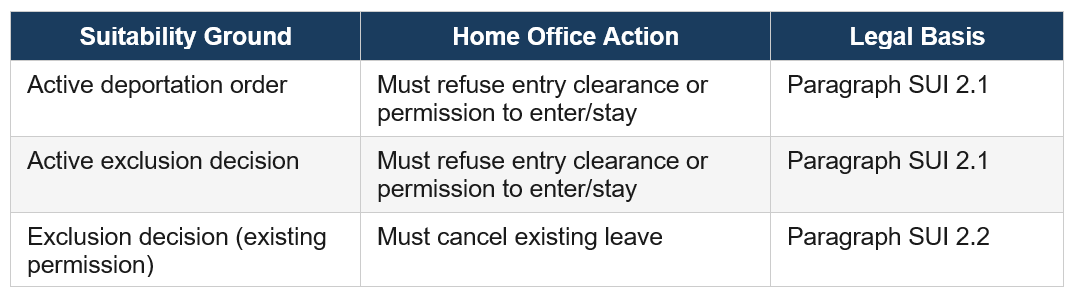
The language of the Rules is deliberate. The Home Office must refuse or cancel; there is no discretion, no balancing exercise, and no room for compelling circumstances to override an active order or decision at this stage. The only route to a successful application is the revocation or lifting of the suitability bar first.
7. Revocation: The Only Route Forward
The Home Office guidance is unambiguous on this point: an application cannot succeed while a deportation order or exclusion decision remains in force. Revocation or the lifting of the exclusion decision must be secured before any substantive immigration application is made.
Revocation is not a simple administrative step. It involves:
• A formal application, usually made from outside the UK
• Detailed legal representations addressing the public interest in maintaining the order or decision
• Evidence of rehabilitation, changed circumstances, family and private life, and any other relevant factors
• Assessment against strict public interest tests
• No guarantee of success, revocation is discretionary and may be refused
Even where revocation is granted, this does not automatically mean that a subsequent application for entry clearance or leave will succeed. The revocation removes the mandatory bar; it does not create an entitlement to leave. A post-revocation application must still satisfy all other eligibility and suitability requirements.
A Critical Warning
• Many applications fail not because revocation was refused, but because the applicant applied for a visa without first securing revocation.
• Submitting a visa application while a deportation order or exclusion decision is active will result in mandatory refusal – regardless of the merits of the application.
• The Home Office fee is not refunded in these circumstances.
• Always address the suitability bar before making any substantive immigration application.
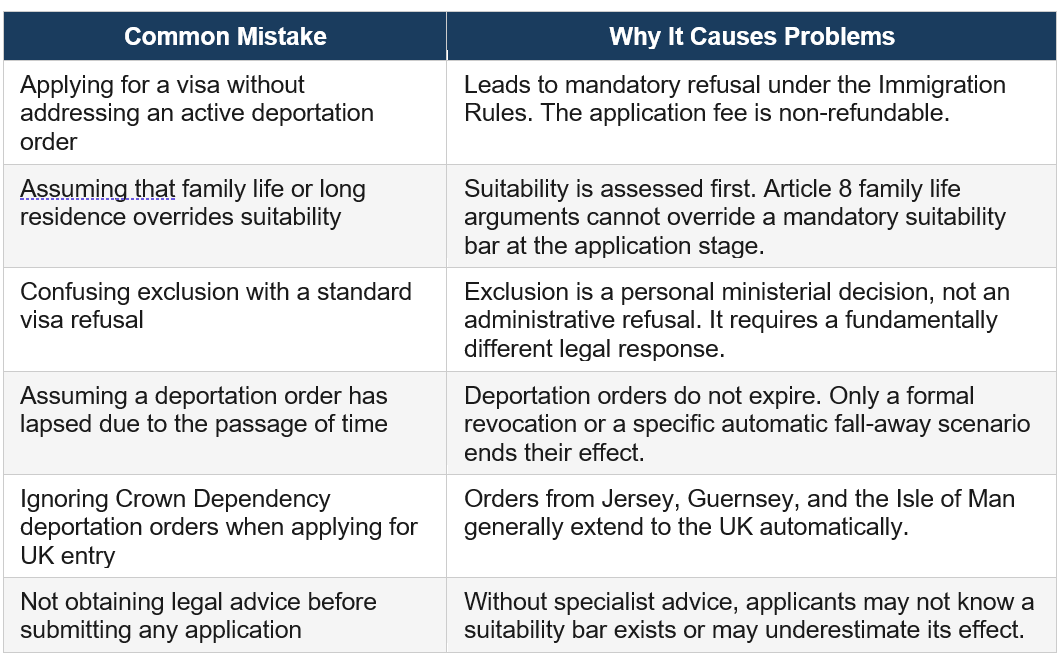
8. Common Mistakes That Lead to Automatic Refusal
In our experience advising on complex suitability cases, the same errors arise repeatedly. Understanding these mistakes can prevent a costly and avoidable refusal.
9. Article 8 and Human Rights Arguments
A question frequently asked by applicants affected by deportation orders is whether human rights arguments, particularly under Article 8 of the European Convention on Human Rights, which protects the right to private and family life, can override a suitability bar.
The short answer is: not at the application stage, and not without revocation.
Article 8 arguments can and do play a role in deportation and revocation proceedings – particularly in cases involving children, long-term residents, and those with deep ties to the UK. However, they must be advanced through the correct legal channels: in an appeal, a judicial review, or as part of a formal revocation application. They cannot simply be asserted in a visa application form as a reason to overlook a mandatory suitability bar.
If you have strong Article 8 or Article 3 arguments, for example, because removal would separate you from a British child or expose you to serious harm, these must be raised in the appropriate legal forum, not in a standard visa application. GigaLegal can advise on the most appropriate strategy for your circumstances.
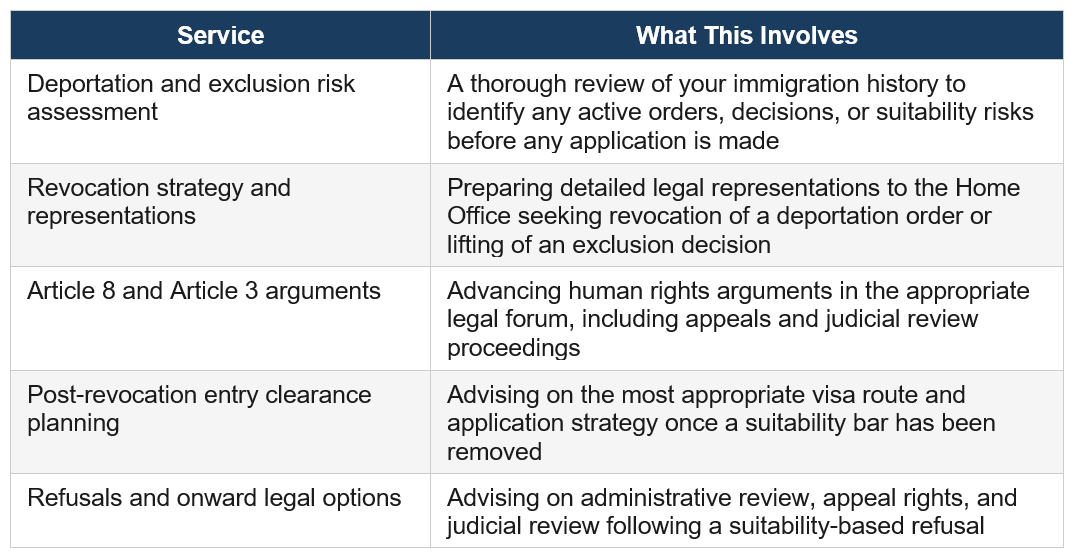
10. How GigaLegal Solicitors Can Help
Cases involving deportation orders and exclusion decisions require specialist legal knowledge, careful strategic planning, and experience in high-risk immigration proceedings. At GigaLegal Solicitors, we advise on the full range of complex suitability matters, including:
The Home Office guidance of 11 November 2025 leaves no room for ambiguity. Deportation and exclusion are absolute legal barriers in the UK immigration system. They operate as mandatory grounds for refusal; they do not expire with time, and they cannot be circumvented by strong eligibility arguments or sympathetic personal circumstances.
In 2026, successful management of these cases depends entirely on three things: identifying the suitability bar early, understanding the correct legal mechanism for addressing it, and applying strategically, not optimistically.
If you are affected by a deportation order or exclusion decision, or if you are unsure whether one may apply to your situation, the most important step you can take is to seek specialist legal advice before making any application.
Concerned About a Deportation Order or Exclusion Decision?
GigaLegal Solicitors provides specialist advice on high-risk suitability cases, deportation order revocation, exclusion decisions, and complex immigration applications. Contact our team before you apply.
How we help?

.png)
Over 400 cases solved
At GigaLegal, we treat your legal matters with the same care and urgency as if they were our own. Our highly experienced solicitors are committed to protecting your rights, freedoms, and future. With a results-driven mindset and a deep sense of responsibility, we work tirelessly to deliver the strongest possible outcome for every client we serve.
.png)
.png)
.png)
.png)
.png)
.jpg)
.jpg)
Aldgate branch
Dagenham branch
.jpg)
Over 1000
success stories
.jpg)
.jpg)
.jpg)
.jpg)
.jpg)

.jpg)
.jpg)
.jpg)